FORNUTRA® - A Leading CDMO Partner for Global Health Brands.
We support global health brands through rigorous formulation, transparent quality control, and agile manufacturing. Because every nutritional supplement we create embodies people's aspirations for a better life.
Functional coffee — coffee enhanced with botanicals, mushrooms, vitamins, or other nutraceutical actives — is now an established product category alongside conventional coffee. For supplement brands, importers, wholesalers, and e-commerce sellers, it offers a practical entry point: you can launch a private label coffee nutraceutical under your own brand without building a roasting or blending facility.
This guide explains how private label coffee nutraceuticals are developed and manufactured — the product types available, how to formulate botanicals into a drinkable cup, how to set caffeine and serving specifications, which packaging and manufacturing options fit, and what quality documentation a buyer should expect. It closes with the questions to ask when choosing a functional coffee manufacturer.
1. Functional Coffee Product Types
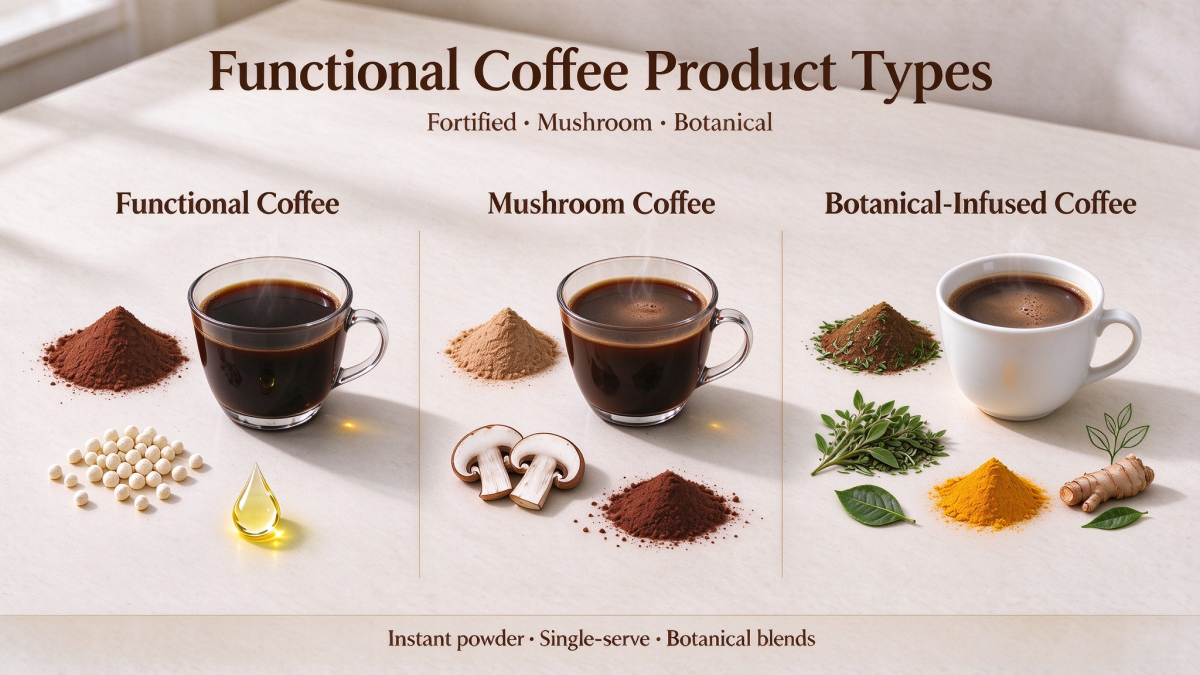
Most private label coffee supplements fall into three categories:
Functional coffee
Coffee enhanced with vitamins, minerals, or active ingredients such as MCT oil, L-theanine, L-carnitine, collagen peptides, or electrolytes.
Mushroom coffee
Coffee blended with functional mushroom extracts such as lion's mane, reishi, cordyceps, chaga, and turkey tail, usually sold as instant powder.
Botanical-infused coffee
Coffee combined with herbal extracts such as ashwagandha, maca, turmeric, or green tea; yerba mate is used as an alternative plant-based caffeine source.
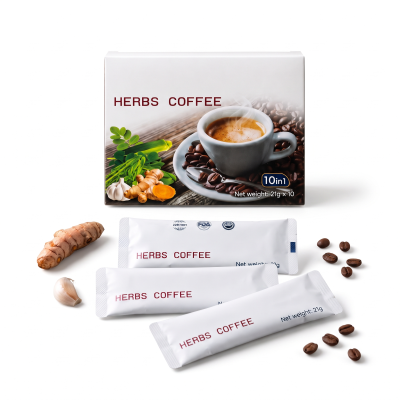
A common starting point is a multi-mushroom blend such as this 10-in-1 mushroom coffee powder, or a botanical option such as these herbs coffee sachets, which combine a coffee blend with herbal extracts in a single-serve format.
Product type
Typical active ingredients
Common formats
Functional coffee
Vitamins, minerals, MCT, L-theanine, collagen
Instant powder, stick packs
Mushroom coffee
Lion's mane, reishi, cordyceps, chaga
Instant powder, single-serve sachets
Botanical-infused coffee
Ashwagandha, maca, turmeric, green tea, yerba mate
Instant powder, sachets, capsules
Functional coffee, mushroom coffee, and botanical-infused coffee are the three core private label product types.
2. Formulation and Ingredient Compatibility
Coffee is a demanding base for functional ingredients. A workable formula must resolve three issues at once: flavor, solubility, and stability.
Flavor
Mushroom and adaptogenic extracts can be earthy or bitter. The formulator selects the roast level and a masking system — sweeteners, natural flavors, and creamers — so the finished cup tastes like coffee first.
Solubility
Instant coffee dissolves readily, but added actives such as fiber, MCT oil, or certain botanical extracts can clump or settle. Granulation and dissolution optimization keep a single-serve stick smooth in hot or cold water.
Stability
Caffeine is inherently stable, but botanical extracts and oils can oxidize or absorb moisture. Microencapsulation protects sensitive actives, while moisture-barrier packaging extends shelf life.
Compatibility between actives matters as much as compatibility with coffee. Caffeine pairs well with L-theanine, and with MCT for a creamier mouthfeel. An experienced botanical nutraceutical manufacturer validates these interactions during formulation rather than assuming them.
3. Caffeine and Product Specifications
Decide the caffeine level per serving early, because it drives labeling, serving size, and the format.
A typical brewed cup contains roughly 80–100 mg of caffeine. Single-serve functional coffee sticks often target a similar 50–100 mg range, while portable formats such as oral pouches may use a lower dose.
Low-caffeine and caffeine-free options are a separate lane. A truly caffeine-free product is either a decaffeinated coffee or a coffee alternative that replaces coffee with a mushroom-only or botanical blend (or L-theanine). Note that mushroom coffee that still contains coffee beans retains caffeine from the coffee, so confirm the caffeine content of your base before positioning a product as caffeine-free.
On safety references: for healthy adults, the US FDA has cited 400 mg of caffeine per day as an amount not generally associated with dangerous, negative effects [1], and EFSA's 2015 safety assessment concluded that single doses up to 200 mg and daily intakes up to 400 mg do not raise safety concerns for healthy adults [2]. These are general safety references, not statutory limits — caffeine ceilings and labeling rules vary by market and product category, so confirm the requirements for each target market before finalizing.
Caffeine tier
Typical per serving
Format fit
Caffeine-free
0 mg (L-theanine / mushroom-only alternative)
Decaf positioning, evening use
Low caffeine
~25–50 mg
Oral pouches, gentle energy
Standard
~50–100 mg
Instant coffee sticks, sachets
Higher
100+ mg (label-checked)
Pre-workout style coffee
4. Manufacturing and Packaging Options
Functional coffee is manufactured in three distinct formats, each with a different production process:
Powder (instant coffee)
Instant coffee is blended with actives using gradient mixing, optionally granulated or spray-dried, then filled into single-serve stick packs or sachets, or multi-serve jars and stand-up pouches. This is the most common format.
Coffee capsules
Roasted and ground coffee (or instant coffee) is filled into single-serve aluminum or plastic capsules for compatible machines — a filling process separate from powder blending.
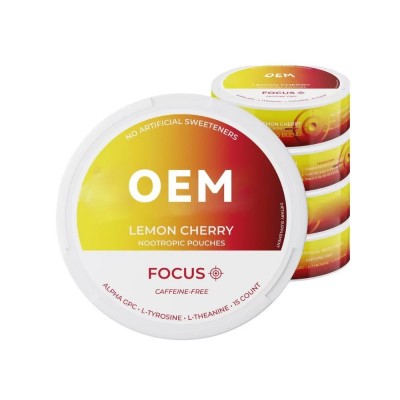
Oral pouches
A soluble blend is sealed in a small non-woven pouch placed in the mouth, with no brewing required — a different production line from powder or capsules.
For powder, a qualified partner works within a defined particle specification (commonly 80–200 mesh) and offers the technologies that keep botanicals stable, including microencapsulation, cold-melt dissolution, and dissolution optimization. FORNUTRA's powder supplement manufacturing covers blending and stick-pack, jar, and stand-up pouch filling.
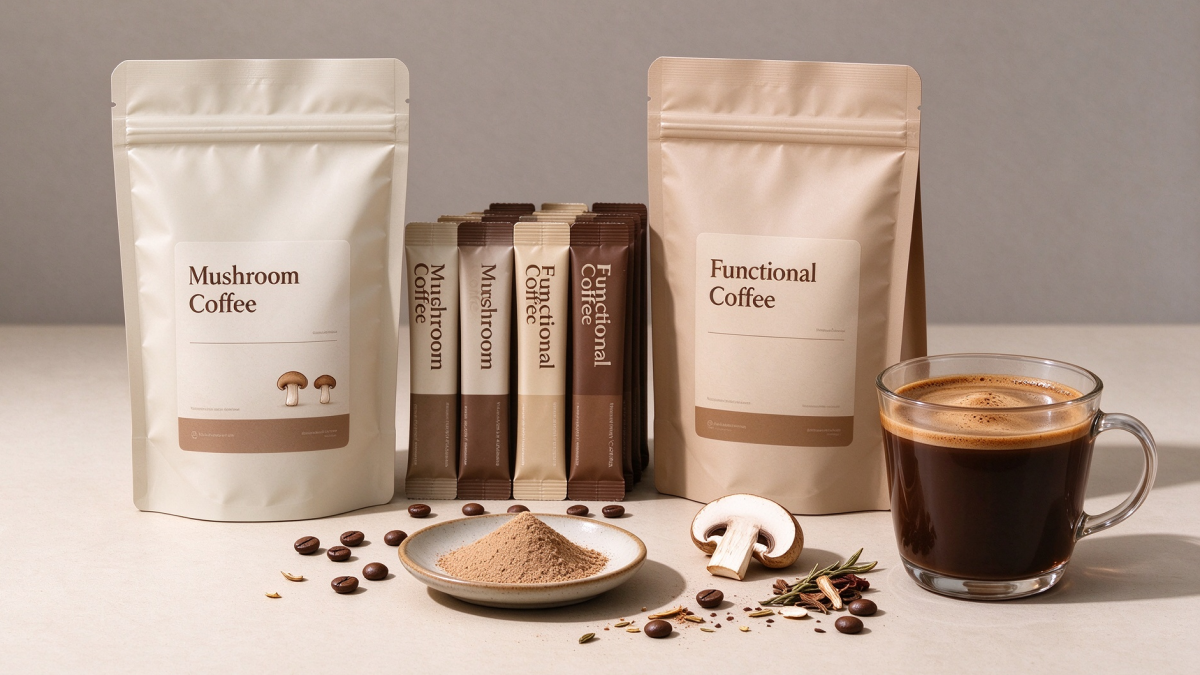
Single-serve stick packs and sachets are the most common format for instant functional and mushroom coffee.
5. Quality Control and Documentation
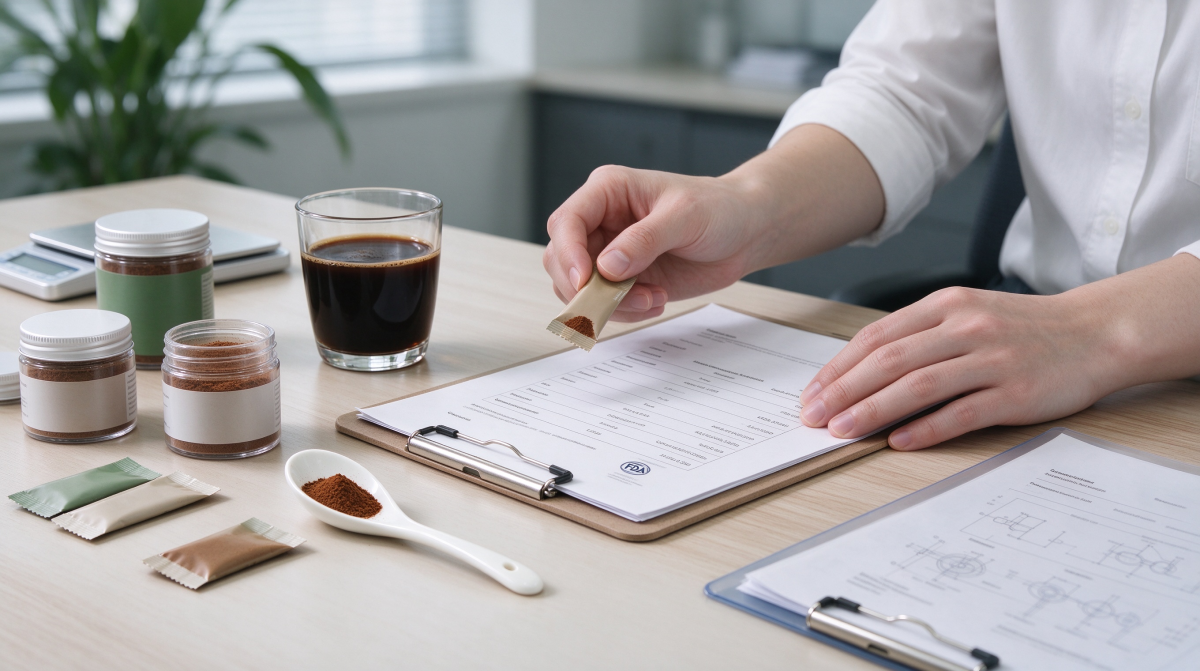
Coffee nutraceuticals ship across borders, so documentation is part of the product. Before you commit, confirm the manufacturer will provide:
Raw material specifications and Certificates of Analysis (COA), with identity testing (such as FT-IR) and 100% incoming inspection.
In-process controls at key production points (FORNUTRA runs 20+ quality-control points) and finished-product testing for heavy metals, microbiology, and active potency.
Stability data, including accelerated (40°C / 75% RH) and long-term (25°C / 60% RH) studies that support the stated shelf life.
Market compliance. For the US, note that the FDA does not approve dietary supplements before they are sold; US facilities must register with the FDA and follow current Good Manufacturing Practices (cGMP) [3]. Certifications such as GMP, NSF, HACCP, ISO22000, HALAL, and BRC are third-party or management-system certifications and are separate from FDA approval.
Traceability, such as one-item-one-code tracking from raw material to finished batch.
6. How to Choose a Private Label Coffee Manufacturer
Use this checklist when evaluating any private label coffee nutraceuticals manufacturer:
Proven formulas. A large formula library (FORNUTRA lists 6,000+ proven formulas) shortens time to market.
Formats and MOQs. Private label powder starts around 200 kg at FORNUTRA — confirm the number for your chosen format.
Sampling speed. FORNUTRA cites a 1–5 day sampling window; confirm it applies to your coffee formula.
Active sourcing and flavor masking. FORNUTRA sources from 200+ suppliers, with 90% from listed or internationally recognized manufacturers.
Stability and QC documentation. Ask for COAs, stability protocols, and testing scope up front.
Registrations and certifications. Match the facility's registrations and third-party certifications to where you will sell.
Scale. FORNUTRA operates 20 production lines in an 8,000 m² Class 100,000 GMP facility.
Confirm sampling speed, COA, and stability documentation before committing to a functional coffee manufacturer.
7. Frequently Asked Questions
What is the difference between functional coffee and mushroom coffee?
Functional coffee is the umbrella term — coffee plus any added functional actives. Mushroom coffee is a specific type of functional coffee whose actives are functional mushroom extracts such as lion's mane, reishi, or cordyceps.
What caffeine level should my private label coffee have?
It depends on positioning. Standard instant coffee sticks usually target 50–100 mg per serving; portable formats use lower doses. Caffeine-free and decaf versions rely on L-theanine or mushroom-only coffee alternatives. Confirm the regulatory rules for each market before finalizing.
What is the typical MOQ for private label coffee powder?
Powder MOQ at FORNUTRA starts around 200 kg for private label. The exact figure depends on the formula, potency, and packaging, and differs for capsules and oral pouches.
Can I get a caffeine-free version?
Yes. A caffeine-free product is typically a decaffeinated coffee or a coffee alternative made from a mushroom-only or botanical blend (or with L-theanine). Regular mushroom coffee that still contains coffee beans is not caffeine-free.
How long does private label coffee development take?
A standard private label project typically runs about 4–8 weeks from formula selection to delivery, with 1–5 day sampling and a 4–6 week production window. Fully custom formulations take longer.
Bring Your Coffee Nutraceutical to Market
A successful private label coffee product comes down to the right formula, the right caffeine and serving spec, and a manufacturer that can document quality and scale with you. FORNUTRA develops and manufactures functional coffee, mushroom coffee, and botanical blends in powder, capsule, and oral-pouch formats. To discuss your formulation, packaging, and production volume, contact FORNUTRA.
FORNUTRA® - A Leading CDMO Partner for Global Health Brands.
We support global health brands through rigorous formulation, transparent quality control, and agile manufacturing. Because every nutritional supplement we create embodies people's aspirations for a better life.